

Information
| Name: | Niki | Position: | Laboratory Teaching Staff |
| Surname: | Lambropoullos | Subject: | Sociocultural Learning - Creative Storytelling without/with AI |
| Email: | niki.lampropoulou[at]upatras.gr | Working Hours: | Tuesday to Friday 9:00 - 17:00 |
| Phone: | 2610-969713 | Google Scholar: | https://scholar.google.com/citations?user=_VULjWQAAAAJ&hl |
-(50 words) Niki Lampropoulou (Lambropoulos), Ph.D., is a writer and screenwriter, and serves as a teaching laboratory staff at the University of Patras, Greece. Her research focuses on creative and digital storytelling within the field of AI Storytelling and Digital Humanities, as well as the pedagogies associated with these practices. She is the editor of two books and the author of academic monographs, short stories, novels, and screenplays. She is also engaged in filmmaking and has extensive teaching experience in her areas of expertise.
-Niki Lampropoulou (Lambropoulos) Ph.D. (Female) is an AI Storytelling expert. She is a researcher/teaching laboratory staff and writer/screenwriter born in Pelopio, Ancient Olympia, Greece. She studied Creative Writing, History of Contemporary Art, and Screenwriting at the University of the Arts London, Sotheby’s Institute of Art, the University of East Anglia, and with Robert McKee in Los Angeles. She holds a BA and Diploma in Education from the Pedagogical Academy of Tripolis in Greece, the University of Athens, an MA in Digital Humanities from the Institute of Education, University College London (UCL), and a PhD in Digital Humanities from London South Bank University.
She has over 30 years of educational experience in primary and higher educational levels in Greece, the U.K. and France; she has worked as an educator, Digital Storytelling, Digital Culture and Digital Humanities expert, and Educational Project Manager. She works as Teaching Laboratory Staff at the Department of Education and Social Work, University of Patras. She is the editor of two books and has authored a total of six books/monographs, three of which are on creative storytelling, published in Greece by Grigoris Publications and in the UK by Cambridge Scholars Publishing. She has extensively published in her research field, writes screenplays for the big screen and has won international awards and accolades (https://www.imdb.me/nikilambropoulos).
| Education: | Education
Creative Writing & Storytelling
|
| Scientific and Research Interests: |
Technical Reports – Research Instruments+ Lambropoulos, N. (2026). The Ideation Evidence Index (Version 1.0) [Research instrument]. DOI: 10.13140/RG.2.2.13003.96806 + Lambropoulos, N. (2026). Emotional Catharsis Scale (ECS–100): A 0–100 analytic scale for the Hero’s Emotional Journey, character transformation and catharsis (Version 1.0) [Research instrument]. DOI: 10.13140/RG.2.2.13255.87203 + Lambropoulos, N. (2026). Storytelling & Artificial Intelligence: Seven Data Normalisation Techniques. DOI:10.13140/RG.2.2.27952.32006 + Lambropoulos, N. (2026). Storytelling & Artificial Intelligence: Qualitative Research Coding Manual. DOI: 10.13140/RG.2.2.33965.86240/1. + Lambropoulos, N., Romero, M. & Demeure, V. (2010). Euro-CAT-CSCL Coding Manual. Technical Report. DOI: 10.13140/RG.2.2.34203.67362. |
| Employment history: | Educational experience in primary and higher educational levels in Greece, U.K. and France. |
| Main Research Work: |
|
| Postgraduate: | |
| Undergraduate: | Undergraduate students’ research assignments
Educational Practice
Creative Storytelling and Multidisciplinary Projects (ESW-422, 8th Semester, Course description) The Project Creative Storytelling course’s main aim is to develop and advance students’ life, soft, digital, and 6Cs skills (creativity, communication, collaboration, critical thinking, connectivity, and citizenship/culture) to increase their metaskills, active participation and engagement in the zone of proximal development/flow for positive psychology and education. To achieve this goal, the course utilises non-traditional pedagogical methodologies such as the project method and creative storytelling, which in turn, support diversity and cultural awareness, multiliteracies, and multimodality. The students learn and work collaboratively in team project work on specific storylines, rules, structures, and methods, first set by Aristotle in Poetics. Upon completion, they will be able to introduce new methods and techniques to their school practices, manage changes and problems, and overall, develop the PERMA-V Positive Education framework (Positive Emotions, Engagement, Relationships, Meaning, Achievement, and Vitality). The 13 lectures/ workshops are the following: 01. Intro – Welcome to the course! Course Aims, and Objectives, Project Team building Evaluation is conducted via an assignment in a small group (2-3 students, 6-9000 words) or individually (3000 words). The first theoretical part refers to the theory and analyses an existing fairy tale/story based on this theory (50%). In the second practical part, the students create a fairy tale/story following the theory (50%). The second part can be an educational scenario, a screenplay, a short story/ screenplay, or a short film, always following the theory for educational purposes. |
| Teaching – Courses: |
|
ORCID: https://orcid.org/0000-0002-7660-5757
-Research and publications are all available to download at ResearchGate: https://www.researchgate.net/profile/Niki_Lambropoulos
-Amazon Author Page: https://www.amazon.com/Niki-Lambropoulos/e/B018WBTIHO
 Contemporary Creative Writing and Storytelling by Niki Lambropoulou and Krystallia Kyritsi explores the connection between theory and practice in contemporary storytelling.
Key themes and content
- Dynamic learning environments: The book examines creative writing and storytelling not only as artistic practices, but also as tools for cultural expression and personal transformation in education and beyond.
- Contemporary education: It analyses the role of writing in an educational context shaped by multimodality and interdisciplinary learning.
- Technological change and digital storytelling: It explores how new technologies are integrated into the production of texts, covering current developments such as multiliteracies, digital storytelling, and storytelling with and without artificial intelligence.
- Practical application: Drawing on theoretical analysis, empirical research, and workshop-based approaches, the second part of the book offers exercises and conceptual tools for applying writing in teaching practice and literature.
The book is intended for educators at all levels, researchers, students, and anyone interested in understanding contemporary developments in storytelling.
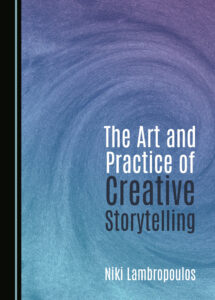
The Art & Practice of Creative Storytelling
The Art and Practice of Creative Storytelling
Drawing on years of research, this book offers a comprehensive guide to mastering the art of creative storytelling, a powerful craft for conveying ideas, beliefs, emotions, and experiences in a captivating way that resonates deeply. By exploring both the outward and inward hero’s journey, it reveals how stories function as timeless life lessons, guiding us toward symmetry, assimilation, and Aristotelian catharsis. Delving into the hero’s journey and the psychology behind storytelling, the book presents it as a subtle yet profound tool, a non-invasive method capable of reshaping individuals and societies. It offers practical techniques, best practices, and a curriculum designed to cultivate narrative intelligence, foster creativity and innovation, and empower readers to shape the stories that define us. By blending traditional and unconventional approaches, it enriches the lifelong learning of storytelling professionals as co-shapers of humanity’s collective experiences and ecosystems.
—
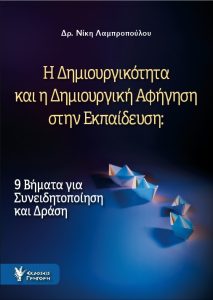
Creativity and Creative Storytelling in Education: 9 Steps towards Awareness and Action
Grigoris Publications, Athens, 2024
PRESS RELEASE
Writer, researcher, educator and screenwriter Niki Lambropoulou explains the importance of creativity and creative storytelling in education through nine steps. She presents key structural elements and good practices to help us experience moments of awareness and creative action.
This 277-page book brings together theories and findings from many years of research, alongside techniques and good practices for developing creativity and creative storytelling in education, communication and everyday life. The nine steps aim to guide readers towards greater awareness and action, enabling visible and underlying changes that can transform ourselves, our surroundings and the society in which we live.
The first part explores creativity as a multifaceted cognitive and behavioural process through which new ideas and solutions are generated. Creativity brings together and builds on a person’s knowledge, skills and abilities, both as an individual and as a member of groups and society. Storytelling is one expression of creativity, as well as a means of communication and self-expression.
Creative storytelling is the art of communicating ideas, beliefs, feelings and experiences in a compelling and engaging way. A story is a dramatised understanding of a life lesson that endures through the narration of the hero’s outer and inner journeys: a passage through “fear” and “pity” towards assimilating the lesson, achieving symmetry and reaching catharsis.
The Hero’s Journey describes the hero’s external journey and commitment to resolving a major problem. The Hero’s Emotional Journey offers a non-invasive approach to supporting the hero’s mental wellbeing and to reconsidering dysfunctional beliefs and behaviours projected onto the characters. The hero begins the journey by facing situations that reveal their shadow and the truth about themselves and the world. Through difficulties and challenges, they come to recognise their fears, weaknesses, strengths and goals. They learn to self-regulate and become more autonomous and resilient, enabling them to continue their journey.
Education’s mission is not only to equip students with knowledge, skills and abilities. It is also to help them become autonomous citizens who express themselves, think creatively, collaborate in groups of different sizes, continue to develop and transform their identities, and adapt their learning to changing circumstances.
The third part therefore brings creativity and creative storytelling together with sociocultural learning and education. It introduces a new teaching model, the Zone of Proximal Flow, along with related pedagogical approaches. It also considers how new technologies can be incorporated into digital storytelling to design, develop and support creative sociocultural learning environments.
In the classroom, creative storytelling can help all students develop soft skills and ensure that they are seen and heard. By including every student in the creative process, it enables them to create collective, multidimensional stories. The book concludes by proposing a new, unified, interdisciplinary framework and curriculum for storytelling across all levels of education.
Moments of awareness and action are not the preserve of a select few. We can all experience them through our own stories or, through empathy, by engaging with the stories of others. In this book, Niki Lambropoulou sets out nine ways to cultivate these moments, transforming individual human experiences into dramatised acts of understanding with universal resonance.
Written in an accessible, encouraging and vivid style, the book goes beyond presenting research findings. It offers analysis, techniques, examples and practical exercises for creative practice, so that readers of every age can discover their creative selves and tell their own stories.
This highly accessible book offers an engaging introduction to—and deeper exploration of—creativity and creative storytelling in education, a combination whose possibilities continue to surprise us.
The book is available in the bookshops.